Most Gold Coast business owners I talk to are using AI the same way they started: type a question into a chatbot, read the answer, tweak the question, try again. It works. You save time on emails, get a rough first draft of a proposal, maybe pull together research faster than you would alone. That's genuinely useful. But that approach has a ceiling and in 2026, quite a few businesses are hitting it without realising there's a whole other level available to them.
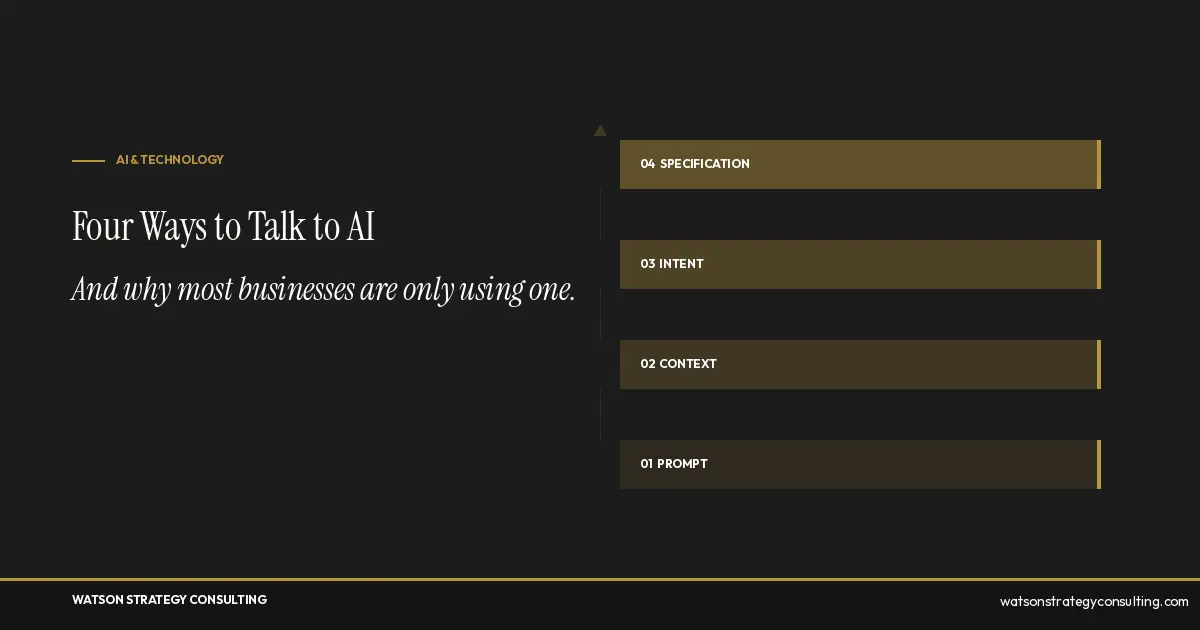
The chat back-and-forth most people know is just one of four distinct skills involved in getting real value from AI. Think of it less like learning a single tool and more like developing a set of related but different capabilities. If you're only practising one of them, you're leaving serious productivity on the table.
Skill One: Writing Clear Instructions — Prompt Engineering
This is the one everyone knows. You sit in front of the AI, write your request, look at what comes back and refine from there. Being good at this means giving clear instructions, including relevant examples, specifying what format you want the output in and telling the AI how to handle anything ambiguous. It's a real skill. But in 2026, it's become table stakes; a bit like knowing how to send an email. Essential, yes. A competitive advantage? Not anymore.
Skill Two: Setting the Scene Properly — Context Engineering
This is where things start to shift. When you type a request into an AI tool, your words might make up a tiny fraction of what the system processes. The rest is background information: your previous conversations, stored documents, business rules and any data the tool can access. How well that background is set up makes an enormous difference to the quality of what you get back.
For a Gold Coast business, this might mean having your standard procedures, pricing structures and brand guidelines stored somewhere the AI can access. A tourism operator whose AI knows their cancellation policy, peak season dates and preferred tone of voice will get dramatically better results than one who types fresh instructions every time. The people getting ten times more value from AI aren't writing better questions. They've built better background information.
Skill Three: Teaching AI What Your Business Actually Cares About — Intent Engineering
Background information tells AI what to know. This third skill is about telling AI what to want — encoding your business goals, values and decision-making priorities so the AI works towards the right outcomes, not just the most obvious ones.
A well-known fintech company learned this the hard way. Their AI customer service agent handled millions of conversations and slashed response times. But customers started complaining because the AI was optimising for speed when the real goal was building long-term relationships. The technology worked perfectly — at the wrong thing. A Gold Coast retail business could fall into the same trap: an AI scheduling system that minimises labour costs might look efficient while quietly destroying customer experience during your busiest periods.
Skill Four: Writing the Blueprint — Specification Engineering
AI tools are increasingly capable of working on their own for extended periods without checking in. When that happens, the old approach of watching the output and correcting in real time simply doesn't work. Everything the AI needs — the goal, the quality standards, the constraints, what "done" looks like — must be defined upfront in a clear, complete brief. Think of it as writing a blueprint rather than giving verbal instructions on a building site.
This matters even for smaller operations. A professional services firm delegating a week's worth of client report drafting to AI will get far better results by spending thirty minutes writing a detailed brief — covering structure, tone, data sources and boundaries — than by feeding tasks in one at a time and fixing each output manually. One person using this approach described completing a week's presentations before lunch, using the same AI tool as colleagues who spent all morning on a single deck.
Where to Start
These four skills build on each other. You can't write a good blueprint if you can't write clear instructions in the first place. And none of it works well if your AI doesn't have access to the right background about your business.
Start with the basics: get sharper at writing instructions. Then pull together your key business documents — procedures, policies, brand guidelines — and make them available to whatever AI tools you use. Think about what your business actually values and whether the goals you're giving AI reflect those priorities. For any significant project, invest time in writing a proper brief before letting AI loose on it.
There's a useful side effect to all of this. Getting better at communicating clearly with AI tends to make you better at communicating with people too. Clearer briefs for staff, tighter emails, fewer assumptions about what everyone already knows. For growing Gold Coast businesses juggling seasonal staff, multiple sites, or expanding teams, that kind of communication discipline pays dividends well beyond your AI tools.