Introduction
Agentic AI refers to autonomous software agents that plan, reason, use tools and execute multi-step business tasks with minimal human involvement. Unlike chatbots, these agents run for hours or days against a defined brief, chaining actions across your systems much like a capable junior employee.
Consider Coastline Escapes, a fictional 25-room Gold Coast beachfront hotel and tour operator. An agentic system could autonomously adjust room pricing based on occupancy and event calendars, handle overnight guest queries, schedule preventative maintenance and generate compliance reports. But none of that works without the right IT foundations.
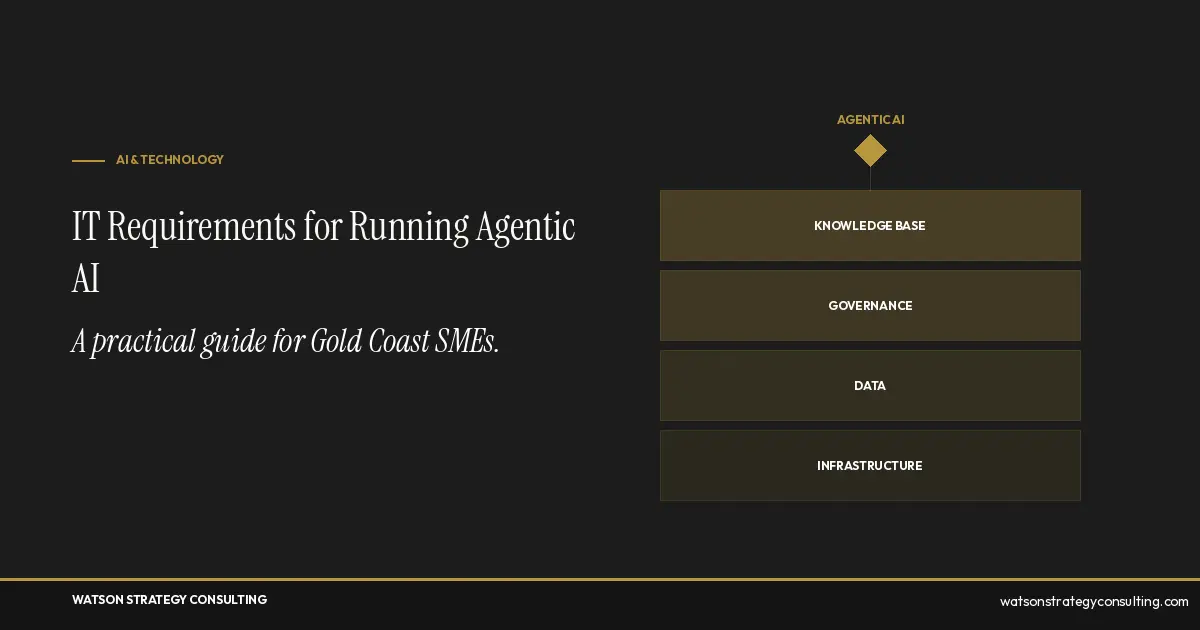
Infrastructure Requirements
For most Gold Coast SMEs, cloud-based infrastructure is the practical starting point. It scales on demand, avoids large capital outlays and keeps maintenance manageable. Coastline Escapes would need its booking engine, guest CRM, supplier contracts, weather data feeds and accounting system connected through APIs (standardised ways for software to communicate with other software). Without those connections, the agent has nothing to work with.
Processing power largely sits with the model provider, so dedicated hardware is unnecessary. However, reliable internet is essential because agents make frequent calls to cloud services. Redundancy matters: if the booking system goes offline mid-pricing cycle, the agent needs graceful fallback behaviour. Budget $500 to $2,000 per month for cloud services and API subscriptions initially, scaling as usage grows.
Data Requirements
Agents are only as good as the data they operate on. Industry research consistently identifies data searchability and reusability as the top barriers to effective AI adoption.
Coastline Escapes' relevant data includes guest booking histories, supplier pricing sheets, tour availability, local event calendars, weather patterns and feedback records. All of it needs to be clean, current and stored in structured formats the agent can query. A guest record in a handwritten logbook is invisible to an AI agent.
Privacy compliance is non-negotiable. Under the Privacy Act 1988 and the Australian Privacy Principles, any SME handling personal information must collect data lawfully, store it securely and use it only for disclosed purposes. The Notifiable Data Breaches scheme requires reporting eligible breaches to the Office of the Australian Information Commissioner. For Coastline Escapes, guest data must be encrypted at rest and in transit, with access controls limiting what the agent can see. Build privacy by design into every data pipeline from day one.
Procedures and Governance
Deploying an agent without clear governance is like hiring new staff and never telling them what the company does or how to make decisions. You get activity but little productive output.
Coastline Escapes needs a written AI governance framework before any agent goes live, defining decision boundaries (adjust room rates within 15% of base price, escalate beyond that), escalation rules (maintenance requests above $1,000 go to the operations manager), human oversight checkpoints and an incident response plan.
Critically, governance must encode organisational intent, not just task instructions. The lesson from enterprise deployments is clear: agents told to resolve tasks quickly will do exactly that, even when the real goal is customer satisfaction. Coastline Escapes should explicitly define that guest experience sits above speed and cost efficiency in the agent's decision hierarchy. Unlike a human employee, an agent will not absorb company culture through hallway conversations. Those tradeoffs must be documented before the agent starts work.
Knowledge Base Development and Maintenance
An agent's knowledge base is the structured information it draws on to make decisions: the institutional memory you would normally transfer to a new hire over six months, except it must all be written down before the agent begins.
For Coastline Escapes, this includes check-in and check-out procedures, tour booking protocols, supplier agreements, cancellation policies, local attraction guides and guest communication templates. These documents must be clearly structured, internally consistent and free of contradictions.
The most cost-effective approach is retrieval-augmented generation (RAG), where the agent searches a curated document library before responding. This avoids custom model training costs while keeping the agent grounded in your actual business knowledge. Version control is essential: when Coastline Escapes updates its cancellation policy for peak season, the knowledge base must reflect that immediately. Assign a staff member as knowledge base owner, reviewing content monthly. Budget $200 to $500 per month for document management tooling.
Additional IT Enablers
Security: Treat every AI agent as a new employee with system access. Implement role-based permissions, multi-factor authentication for admin functions and scoped access. Coastline Escapes' concierge agent should not access financial records; its pricing agent should not touch guest personal details.
Monitoring and cost controls: API usage can escalate fast. Set spending caps, monitor token consumption daily during the first quarter and establish alerts for unusual activity. A pricing agent caught in an error loop at 2am could burn through a month's API budget without safeguards.
Staff training: Your team does not need to become engineers, but they must understand how to provide clear, complete instructions with enough context that the agent can execute without constant supervision. Invest in practical sessions focused on your specific workflows. Budget $1,000 to $3,000 for initial upskilling.
Conclusion
Agentic AI is accessible at SME-scale budgets today. What separates businesses that extract genuine value from those wasting money is not the AI model itself. It is the quality of the foundations beneath it: clean data, clear governance, a maintained knowledge base and sensible security. The businesses that build these foundations first will hold a compounding advantage as agent capabilities accelerate through 2026.
Implementation Roadmap
- Audit and Map. Document every system in use. Identify which expose APIs and which are data silos. List all data types containing personal information.
- Data Clean-Up. Digitise paper records. Standardise data formats. Conduct a privacy impact assessment under the Australian Privacy Principles.
- Governance and Knowledge Base. Draft the AI governance framework with decision boundaries, escalation rules and value hierarchies. Compile the knowledge base with core SOPs and policies in agent-readable formats.
- Pilot and Train. Select one low-risk use case (e.g. automated guest FAQ responses). Connect via RAG. Run a supervised pilot with human review of every output. Train the team on oversight and feedback.