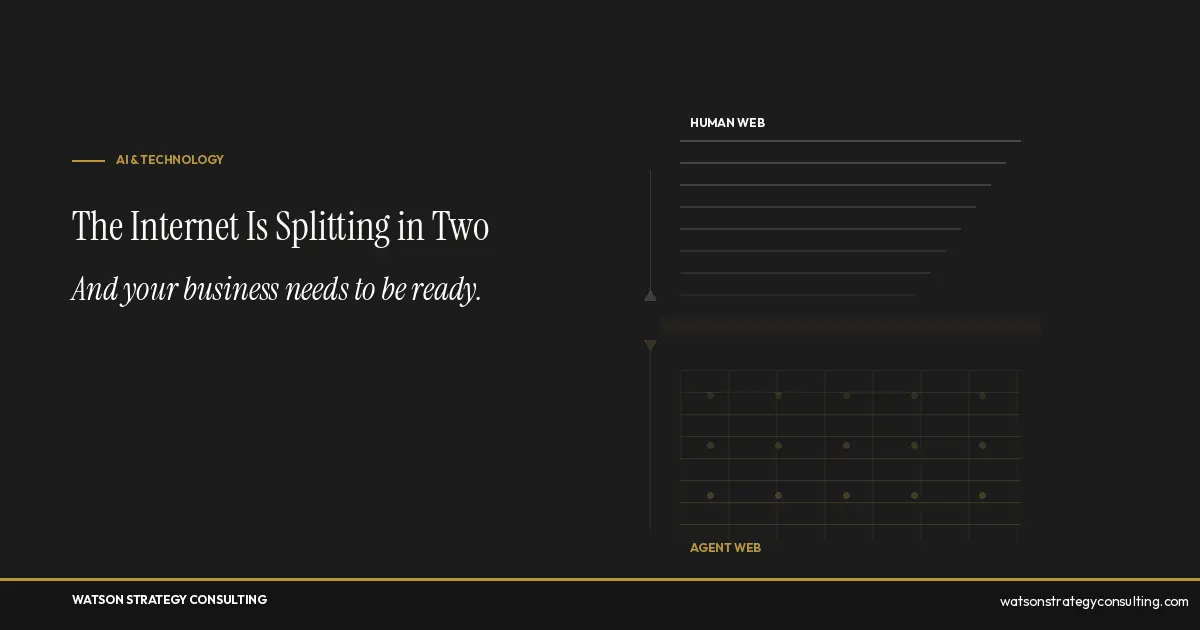
If you run a business on the Gold Coast, you've probably noticed something shifting. Customers are using AI tools to research restaurants, compare trades quotes, book accommodation, even shortlist professional service providers. That's the tip of a much bigger change. Behind the scenes, the internet itself is splitting into two layers: one built for people and another built entirely for software. Understanding what that means could be the difference between thriving and scrambling to catch up over the next few years.
Here's the simplest way to think about it. When someone Googles "best electrician Burleigh Heads," they see a webpage with photos, reviews, maps and ads. That page is designed for human eyes. But increasingly, AI agents — software that acts on behalf of a person — are doing the same searching. They don't need pretty layouts or scroll animations. They need clean, structured data they can read and act on instantly. So tech companies are building a parallel version of the web specifically for these agents. It's happening right now and the pace is genuinely surprising.
The Payment Layer Is Already Changing
The biggest names in global payments have all reached the same conclusion almost simultaneously. Stripe, Visa, PayPal, Google and Coinbase are each building systems that allow AI agents to make purchases and handle payments without a human clicking "buy." Stripe has created tools letting businesses connect their product catalogue so AI agents can complete purchases on a customer's behalf. They even had to rebuild their fraud detection from scratch, because decades of security models were calibrated around human shopping behaviour — mouse movements, browsing time, device fingerprints. None of that works when the buyer is software.
Think about what this means for a Gold Coast tourism operator or retailer. Within a couple of years, a significant chunk of bookings could be initiated not by a person tapping their phone but by an AI assistant acting on instructions. "Find me a beachfront apartment in Coolangatta for Easter weekend under $300 a night and book the best option." If your business isn't set up so these agents can find you, read your availability and transact, you're invisible to a growing segment of demand.
Content and Search Are Shifting Too
Content access is shifting just as fast. Cloudflare, which handles roughly a fifth of all web traffic, has started automatically converting websites into a format AI agents can read. They've also launched tools letting site owners make content directly discoverable to agents, bypassing traditional search engines altogether. For a local business, this matters. It's no longer enough to optimise your website for Google. You'll increasingly need your information structured so AI tools can parse and act on it — cleaner product data, standardised pricing and proper booking system integrations.
The search landscape is changing too. Google built its search engine for humans: ten blue links, ads, featured snippets. But AI agents need structured data they can process and act on immediately, not a page of results to browse. New search engines are being built specifically for machines and the companies that own their own search infrastructure have a real speed advantage when agents are chaining multiple searches together in seconds.
The Smartphone Parallel
There's a useful parallel here. When smartphones took off after 2007, the web existed but was built for desktops. The mobile experience was terrible. What followed was a massive rebuild: responsive design, mobile apps, tap-to-pay. The companies that built for mobile early became the dominant players of the next decade. We're at a similar inflection point, except the new "client" isn't a smaller screen. It's software that reads, decides, pays and acts without ever opening a browser.
What Gold Coast Businesses Should Do Now
This doesn't mean you need to panic or overhaul everything tomorrow. But it does mean you should start paying attention. For most Gold Coast SMEs, the practical steps are straightforward.
First, make sure your business information is clean, consistent and well structured across your website, booking platforms and directories. If an AI agent can't easily pull your prices, availability, or services, it'll move to a competitor who makes that accessible.
Second, keep your technology stack current. If you're using a booking engine, POS system, or e-commerce platform, check whether your provider is building towards agent compatibility. Many major platforms already are.
Third, don't get sucked in by hype. There's plenty of noise about AI bots that can supposedly turn fifty dollars into thousands overnight. The reality is far less glamorous. The genuine opportunity for local businesses isn't in speculative trading — it's in being positioned to capture demand as the way people search, compare and buy continues to evolve.
The Bottom Line
The Gold Coast economy runs on tourism, hospitality, trades, retail and professional services — all sectors where customers already use AI tools to make decisions faster. The businesses that get found, understood and booked by these new agents will have a genuine edge. You don't need to become a tech expert to stay ahead. But you do need to recognise that the internet your customers use is changing and your business needs to be ready for both versions of it.